 Getty Images/iStockphoto
Experts say agents could soon automate various ERP workflows, but the risk of error is significant, and the necessary data infrastructure and business context aren’t yet in place.

Analysts suggest progress has been more incremental than that.
It’s true that generative AI (GenAI) and agentic AI in ERP are making real gains across unglamorous areas like robotic process automation (RPA) and process mining, and enterprises are starting to deploy it for real — from generating board-ready financial briefing books to fighting AI-generated fraud. But when the technology is applied poorly, flipping the AI switch and expecting process excellence can introduce new risks when the AI isn’t grounded in strong data and governance foundations, which most enterprises haven’t built yet. And the reliability ceiling looms overhead whenever the work requires deep business context.
There is a recurring tension in crafting an adoption strategy that hits the sweet spot between genuine reimagination and overreach. Agents can demolish time sinks and automate problems no one ever bothered to automate. But AI can become a liability when it is pointed at high-stakes, context-heavy decisions like tariffs, compliance and supply chain regulation. That means the easiest AI wins might require bounded domains, clean data and business knowledge that can be scraped off the public web.
How the major vendors are pitching agentic ERP
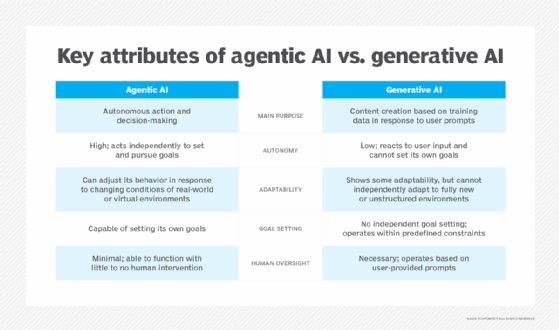
The big ERP vendors have converged on nearly identical language. SAP, Oracle, Microsoft and Workday all describe the same arc: ERP is evolving from a system of record that logs what happened to a system of action or outcomes that decides on and does the work. Underneath the slogans, they draw the same line between a copilot, which suggests a next step and waits for a person to act, and an agent, which reasons over enterprise data, makes decisions and executes multi-step work across systems with limited human input.
Beneath the matching slogans is a spectrum of ideas about where the agent lives. At one end, the agents live inside the system of record, on the argument that governance, audit trails and permissions come built in when the agent never leaves the transactional system. At the other end, agents meet the work across applications through an orchestration or connector layer. This approach trades tight coupling for reach and flexibility while taking on the burden of maintaining the connectors that stitch the systems together. Over time, all the major ERP vendors will likely tune their offerings to support each customer’s sweet spot.
Midmarket and second-tier ERP players differentiate less on the agent story than on their particular focus. Some lean on vertical depth and ship agents that are preconfigured for specific industries such as manufacturing, distribution or asset-heavy operations. Others compete on value and data sovereignty, pairing lower per-user pricing with a pitch that customer data and the underlying AI model stay in-house.
Separately, a wave of venture-backed, AI-native finance and ERP startups is going after the back-office core directly, promising things like a near-instant financial close and arguing that legacy systems are clunky and slow to implement. But these startups will face challenges competing with legacy vendors’ integration breadth and compliance depth, along with the plain difficulty of persuading a company to rip out and replace the system its books already run on.


Leave a Reply